Norwich Progressive Jewish Community

  • Home
  • About Us
    • Who we are
    • Our rabbi
    • Our Torah scroll
    • Our congregation
    • Our council
    • Charities we support
    • Jews in Norwich
    • Movement for Progressive Judaism
    • Board of Deputies
  • Services and Activities
    • Calendar
    • Monthly Shabbat Services
    • High Holy Days
    • Hebrew Calendar
    • Observing Yahrzeits
    • Friday Evening Messages
  • Education
    • Adult Education
    • Cheder and Kabbalat Torah
    • Conversion
    • Hebrew for Adults
    • Joan Goodman Lectures
  • Resources
    • Bereavement
    • Care Group
    • Constitution
    • Membership
    • Privacy Notice & GDPR
    • Safeguarding
    • Web Links
  • Photo Gallery
  • Contact Us
    • Online Contact Form
    • Support NPJC

From the Rabbi – Aug/Sep 2023

I am writing this at the end of my stay in Israel. I have been here for more than six weeks. Weeks in which I was not the only one to move from one profound experience to another, for the country did the same. For many months there have been protests, which only intensified over time. Four weeks into my stay here the Knesset approved Netanyahu’s controversial legislation, which curtails the Supreme Court’s power.

The weeks have also seen violence. On the day I arrived in June a group of settlers went into the village of Turmusaya and created destruction. Houses and cars were set on fire and one man was killed. I visited Turmusaya in the last week of my stay here. Then I spoke to the mayor and witnessed some of the burnt out places. More than 90% of the town’s inhabitants are American-Palestinians, who moved to the village on their retirement. It was hard to witness, yet there was also a sense of hope and defiance. Some of their children expressed the desire to join their parents and move to Turmusaya in the coming year.


Being here has brought the difficult political situation to the fore. It is of course on the forefront of everyone’s mind. One Sunday morning I joined a group of rabbis and comics, who meet every Sunday in a spacious grand café in Baka, Jerusalem, where they discuss life in general as well as the parashah of the week. I have rarely seen the bible read with more urgency for its time, in a way that was both funny (there were comics after all) and deeply serious.

And all of this is part of everyday life. On one of my first days in Tel Aviv I was introduced to the
city’s wonders by a friend: I drank my first etrog juice at Etrog Man, I saw the divided shops for
sabich (pita stuffed with fried aubergine, hard boiled eggs, salad and tahini) and falafel of the
brothers Frishman, and I walked through part of the white city. My bus back to the apartment was
delayed, yet I did not make much of that until much later, when I realised that its delay was a result
of an attack at a bus stop in the northern part of the city. One of my classmates at Ulpan lived in
that same street. “Close to the attack?”, our concerned teacher asked. “Oh no,” was the casual
response, on the other end.

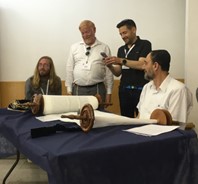
My stay was mostly organised by myself and one fellow student from LBC, but from time to time we joined a group of reconstructionist rabbinical students on visits to the Westbank, the Galilee and the Negev. In the first week, I studied at Pardes, in Jerusalem, where I also attended the inauguration of a brand new, very white torah scroll. It moved me to see the new scroll and to think of the various scrolls I normally leyn from, including ours’, and of theirhistories. The scribe must have read my thoughts for he too spoke of scrolls with complex histories. A scroll, he said, is not just the text, but it is also its history. He hoped for a good history for this one. (In the picture you see him ready to write the last three vowels. The ink-pot is on the scroll, safely on a piece of paper.) My travels also brought me on a late night bus to Jerusalem, when the protests combined with a computer error completely stopped all trains in the country. A woman sat down next to me and we started talking. She had made aliyah forty years ago, from Hendon. The journey became a conversation about North London, Kabbalah and the difference between British and Israeli cucumbers.

There is of course much more to tell: of beautiful quiet nights walking back to my hotel in
Jerusalem, of praying with the Women of the Wall, of swimming in very warm water in Yafo, of the
many beautiful murals, of the enormous cockroaches, of erev shabbat service in the park, of the
wonderful hospitality I received. I am still gathering my thoughts and I am sure I shall return to
some of my experiences in the weeks and months to come. I am looking forward to seeing many of you in the first weekend of September when we start our preparation for the Yamim Noraim. The services on Rosh Hashanah and Yom Kippur, will be led by two wonderful future colleagues of mine, and many of you are leading parts as well. As always, do contact me for a conversation, with concerns, or with joyful stories.

The best way to contact me is to send an e-mail, so we can find a good to time for us to meet.
l’shana tov

Hannah
From the Rabbi – June 2023

I am writing this as I am finishing my last essays for this academic year at Leo Baeck College. One of them concerns God’s call to the first man in the garden of Eden in Genesis 3: 9, ‘Ayekha, where are you?’

This question has puzzled the rabbis, because, as some argue, God knows everything and thus knows very well where the man is. So, just to make sure that no one thinks otherwise, they amend God’s speech. The new version starts by making explicit that all is revealed before God, light and darkness and all of creation. Only then comes the question, also amended.

Other rabbis make a connection between God’s question in this verse (ayeka) and the first word of Lamentations (eicha, how), as these words are spelled the same without vowels in Hebrew (aleph-yud-kaf/chaf–hey). God’s question is understood as reproof or lamentation. Again, God knows very well what has happened and has already condemned it.

Yet others consider God’s question a model for good manners. When entering, or interestingly also when leaving someone’s house, one should always ask for permission it is argued, just as God called out to the first man. Never just enter or get up and leave.

I find myself most of all intrigued by more contemporary readings, especially by those who are inspired by Martin Buber’s, The Way of Man, According to the Teachings of the Hasidim. Now the question becomes more genuine and is asked not just of human beings, but also of God. The Dutch rabbi Avraham Soetendorp puts it thus: ‘… the critical dialogue between God and humans never ends. God calls, ‘Ayeka, where are you, human being?’ The human being calls to God: ‘Ayeka, where are you, God?’ In the original Dutch, this conversation feels very intimate, as they address each other with the informal ‘you’.

‘Where are you?’ is a question to ask oneself from time to time. More than a year has passed since we last had to move services online because of Covid, and in some ways, things seem to have gone back to how they were. Yet the consequences of the disease and the protective and preventive measures are still with us. For some of us, it may seem as if we have not had a break for years. Others are struggling with the social consequences or with mental health issues. I hope that this summer will allow us all some time to sit and reflect and ask ourselves, not in a judgmental way, but as a genuine enquiry, where am I and where are we?

I wish you all a very good summer. I shall be in Israel from 21 June to 6 August. I can be contacted there via my usual e-mail address and we can always find a way to talk. In August, I am taking some weeks off (6-28 August) and then I’ll be back in Norwich on the first of September for Selichot.

Hannah

(Student Rabbi)

From the Rabbi – May, 2022

In the service of 7 May I used an excerpt from a text by the French philosopher Simone Weil (1909-1943).
Weil is an inspiration for the way she combines her religiosity with very concrete political actions. In this, she touches on some of the central values in liberal Judaism, though Weil’s determination is of a unique kind. It makes her thought so exceptional, but also difficult. Her writing needs to be read slowly and more than once.

What strikes me in the excerpt I have included, is that she holds that there is something in any human being that expects the good from people. This she calls ‘the sacred’ in every human. It is often silenced in those who are powerless. They don’t have words to express injustice being done to them. Their words sound irrelevant, or shrill, or they stumble when they speak. Weil’s text presents a powerful warning against not being swayed by suave words, but also an appeal to listen to uncomfortable or halting speech.

Lastly, as I have to concentrate on work for the college and other responsibilities, I shall have to reduce my contributions to NLJC’s wonderful newsletter. So, you will not see ’From the Student Rabbi’ every month, but I aim to keep contributing from time to time.

The excerpt – I hope it will speak to you too.

From Simone Weil, ‘The Person and the Sacred’

At the bottom of the heart of every human being, from earliest infancy until the tomb, there is something that goes on indomitably expecting, in the teeth of all experience of crimes committed, suffered, and witnessed, that good and not evil will be done to him. It is this above all that is sacred in every human being.

Every time that there arises from the depth of a human heart the childish cry … ‘Why am I being hurt?’, then there is certainly injustice. For if, as often happens, it is only the result of a misunderstanding, then the injustice consists in the inadequacy of the explanation.

In those who may have suffered too many blows, in slaves for example, that place in the heart from which the infliction of evil evokes a cry of surprise may seem to be dead. But it is never quite dead; it is simply unable to cry out anymore. It has sunk into a state of dumb and ceaseless lamentation.

And even in those who still have the power to cry out, the cry hardly ever expresses itself, either inwardly or outwardly, in coherent language. Usually, the words through which it seeks expression are quite irrelevant.

That is all the more inevitable because those who most often have occasion to feel that evil is being done to them are those who are least trained in the art of speech. Nothing, for example, is more frightful that to see some poor wretch in the police court stammering before a magistrate who keeps up an elegant flow of witticisms.

Apart from the intelligence, the only human faculty which has an interest in public freedom of expression is that point in the heart which cries out against evil. But as it cannot express itself, freedom is of little use to it. What is first needed is a system of public education capable of providing it, so far as is possible, with means of expression; and next, a regime in which the public freedom of expression is characterised not so much by freedom of expression as by an attentive silence in which this faint and inept cry can make itself heard; and finally, institutions are needed of a sort which will, so far as is possible, put power into the hands of men who are able and anxious to hear and understand it.

The full text is available here, under a different title: https://lib.tcu.edu/staff/bellinger/rel-viol/Weil.pdf

Dr. Hannah M. Altorf

From the Rabbi – November 2021

This weekend marks Jewish Women’s Aid Shabbat, a fully cross-communal event supported by the Office of the Chief Rabbi, United Synagogue, Reform Judaism, Liberal Judaism, Masorti Judaism, S&P Sephardi Community, Jewish Leadership Council and the Board of Deputies.

According to Jewish Women’s Aid’s website:
“The goal is to focus our community on the issue of domestic abuse and sexual violence, and generate important conversations that lead to a culture change.”

Sadly, no community is immune from domestic abuse. As we reach nearly two years of the pandemic, the lockdowns caused a spike in cases of domestic abuse as people were trapped in with their abusers. In this last year alone, it was estimated that 1.6 million women were victims of domestic abuse. When we speak of domestic abuse, it is not just physical violence that is being spoken of. Since 2015, coercive control was recognised in law. Coercive control is a continuing “act or pattern of acts of assault, threats, humiliation and intimidation or other abuse that is used to harm, punish, or frighten their victim.” (cps.gov.uk)

Jewish Women’s Aid has wonderful resources to help educate our communities and support those going through physical abuse or coercive control. So often in tight-knit communities, rather than being held and protected, people can feel constrained and may feel  reluctant to share the truths of their relationships, if they fear it will damage the name of a loved congregant. No one should have to suffer at the hand of another. If you are concerned about yourself, a friend or a loved one, please know that Jewish Women’s Aid is there for you.

Rabbi Anna Posner

From the Rabbi – October 2021

As we entered into the New Year, we rerolled the scroll and began our story back at the beginning. Bereshit, in the beginning, God created all that was. Often, we read the story as binary; light and darkness, day and night, land and sea. Yet we know that as we follow the light through the day, from morning to night time, it changes in increments; twilight, dawn, dusk.

The stories in Genesis, before Abraham, are universal stories of humanity. No tribe is set, no religion. In creation, we learn that all humans are created in God’s image. Famously, when asked the ‘golden rule’ of Judaism, Rabbi Hillel answered, “Treat your neighbour as you would want to be treated.”  Rabbi ben Azai argued that the word ‘neighbour’ is too narrow. In fact, the golden rule should be to remember that all humans were created in the image of God and we are all descendants of Adam.

In Exodus, we’re taught that all people whose hearts moved them, contributed to the building of the Mishkan (Tabernacle). The artists who were wise of heart brought the plans, and the women whose hearts stirred them spun the goat’s hair. Together the Israelites built the tabernacle where God would dwell. Upon the Mishkan sat two cherubim, from the root keruv, to draw close. The two cherubim facing each other teaching us, according to Torah scholar Avivah Zonberg that, “God is in the place where the two gazes intersect.”

The divine is found in connection and relationship, and through those divine encounters, we are moved and changed. Divinity is found in the connection between, and knowledge and truth are found in an understanding that often, when things seem binary, we must look for the twilight.

Rabbi Anna Posner

« Previous Page
Next Page »

Latest News

Jurnet’s House

Limmud

MPJ & other Events

Copyright © 2026 · Site created by Business Equip · webmaster